
Home Cabinets Solution

Ideal No Compromise

Home / All / Wardrobe Design & Planning / Custom Wardrobe Design Guide 2026: From Site Measurement to Final Installation

Custom Wardrobe Design Guide 2026: From Site Measurement to Final Installation

Jun 8,2026

Custom Wardrobe Design Guide 2026: From Site Measurement to Final Installation

A streamlined, engineer-approved framework for architects, builders, and homeowners to execute flawless built-in wardrobe projects.

Investing in a custom wardrobe design is the ultimate way to maximize storage and elevate room aesthetics. Unlike mass-produced flat-packs, a bespoke solution fits your space's exact contours, utilizing every millimeter from floor to ceiling.

Achieving a premium finish requires a structured, technical approach. This guide distills our proven, step-by-step framework into clear, actionable milestones.

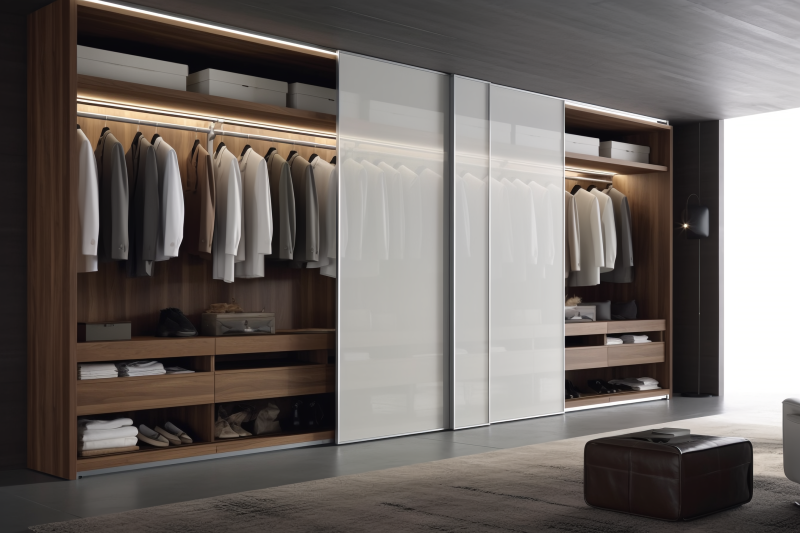
Premium Modern Custom Built-in Wardrobe Finished Project

High-end modern floor-to-ceiling wardrobe system showcasing premium spatial integration.

The 5-Step Project Framework

Step 1: Client Site Measurement & Space Assessment

The foundation of any successful wardrobe project is accurate physical dimensions, completed by the client. Structural anomalies like unplumbed walls or uneven floors are common and must be noted early.

Engineering Insight: With our extensive global project experience, our design team pro-actively accounts for structural variances during the design phase. We engineer solutions for potential alignment issues early, ensuring your on-site installation proceeds flawlessly.
  • Wall-to-Wall Width: Measure at the top, middle, and bottom. Use the smallest dimension as your baseline.
  • Ceiling Height: Check multiple points to identify any structural slopes.
  • Obstructions: Map out power outlets, light switches, baseboards, and window trim.
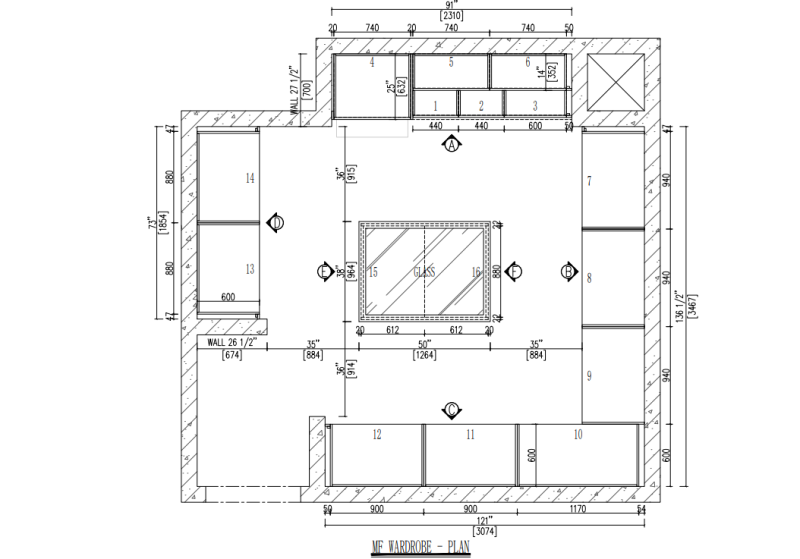
Custom Wardrobe Layout and Clearance Allocation Matrix

Technical layout blueprints mapping space clearances, framing structural variances, and mapping room constraints.

Step 2: Optimizing Layout & Wardrobe Dimensions

Using your provided measurements, our design team optimizes internal ergonomics. We strictly adhere to proven international standards to maximize everyday usability:

  • Overall Depth: Standard external depth for hinged doors is 600mm. For sliding doors, allocate 650mm to 700mm to clear internal tracks.
  • Hanging Sections: Double-hanging rails require 1000mm to 1100mm of vertical clearance; long coats and dresses require 1500mm to 1600mm.
  • Shelves & Drawers: Maintain widths of 400mm to 450mm for folded clothing. Position drawer banks below 1200mm for natural accessibility.
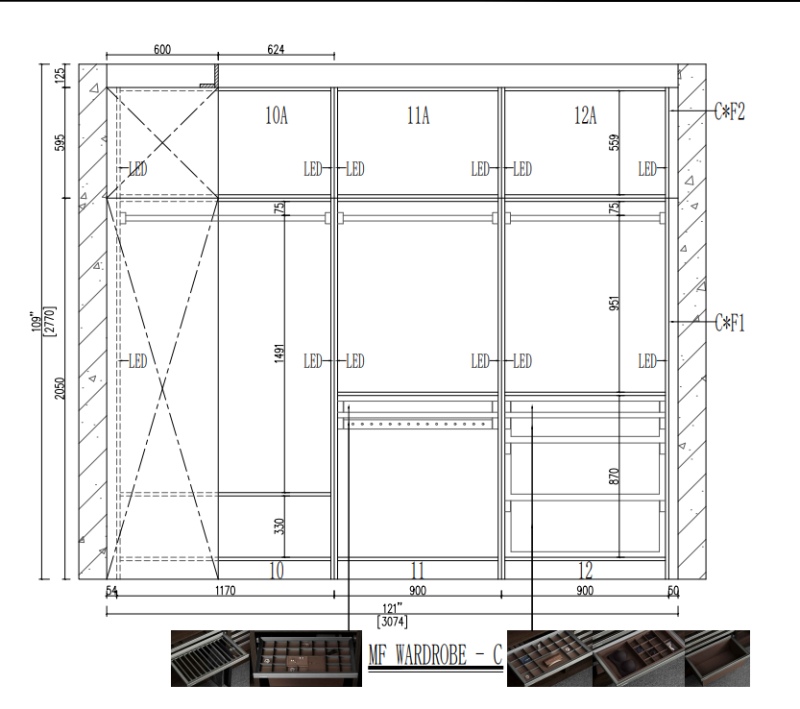
Standard Ergonomic Wardrobe Height Planning and Zoning Allocation

Architectural chart detailing optimal height zoning, shelf divisions, and ergonomic vertical clearance planning.

Step 3: Hardware & Material Selection

A premium built-in wardrobe demands structural integrity. Material and hardware choices should always reflect heavy-duty industrial standards:

  • Core Substrates: For internal carcase structures, specify high-grade moisture-resistant Particleboard or structural Plywood to guarantee long-term stability and sag resistance.
  • The Hardware Standard: Never compromise on moving mechanisms. We specify world-class European hardware systems like Blum for integrated soft-close actions. For budget-optimized projects, top-tier brands like DTC deliver exceptional industrial reliability.
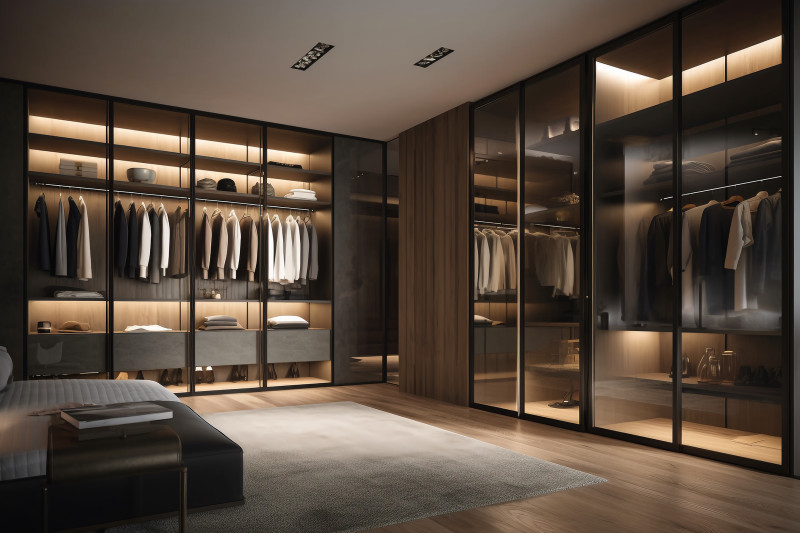
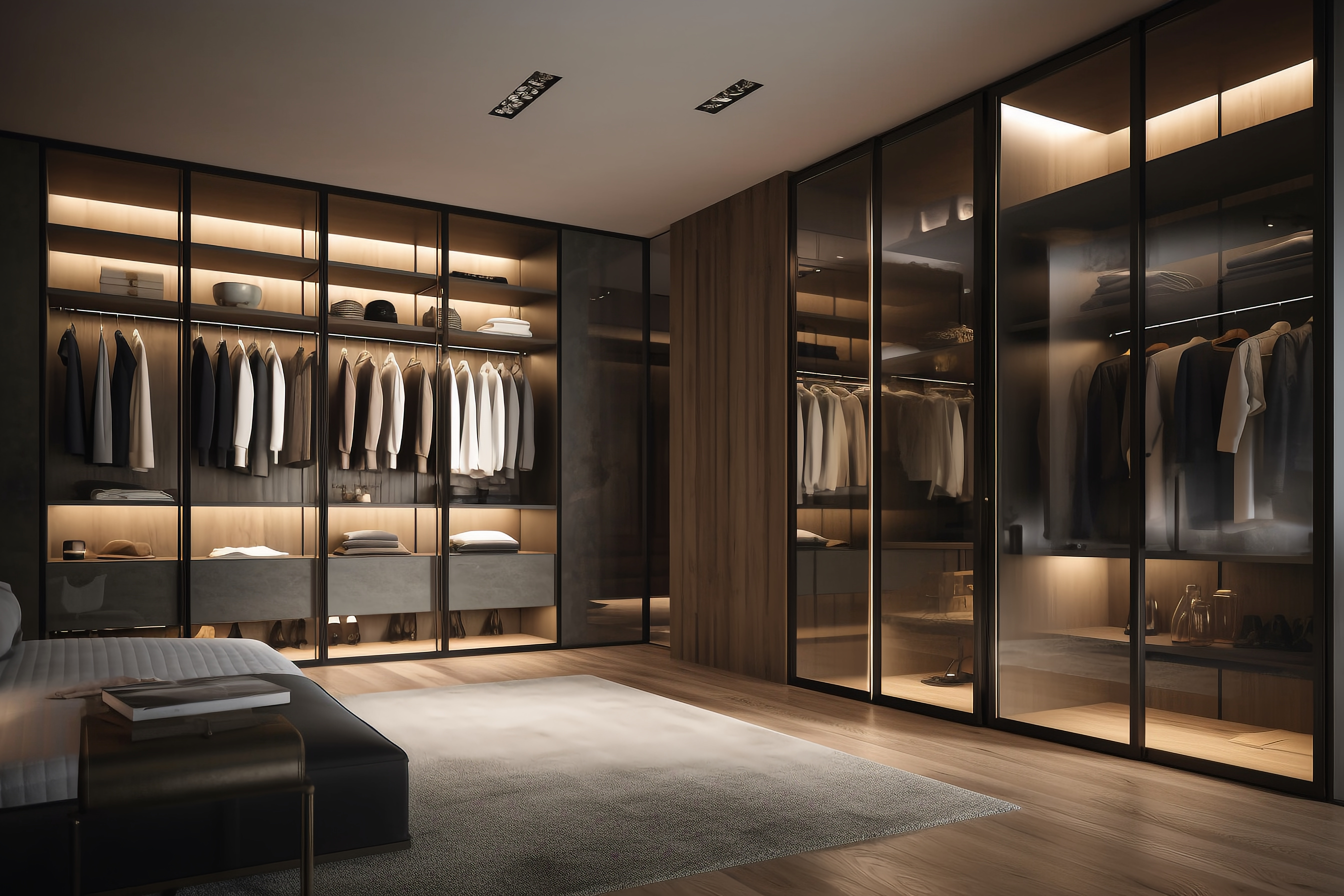
Bespoke Wardrobe with Premium Glass Doors and Integrated Lighting

Sophisticated glass-door wardrobe finish showcasing integrated aluminum profile frames and internal showcase aesthetics.

Step 4: 2D Workshop Drawings & Final Sign-off

Before engineering production begins, your approved design concept is translated into highly technical, production-ready 2D workshop drawings detailing every structural joint, edge-band, and hardware positioning.

To guarantee a perfect fit, we require clients to thoroughly review these technical drawings, execute a final cross-check of dimensions on-site, and sign off to confirm absolute accuracy. This precise review loop ensures manufacturing matches your space seamlessly.
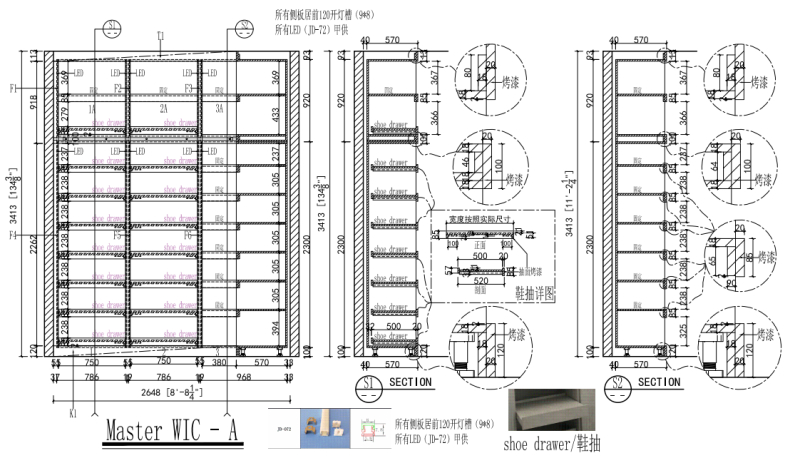
Detailed 2D CAD Workshop Drawing for Custom Furniture Production

Professional 2D shop elevation layout utilized for millwork verification and precise manufacturing tolerances.

Step 5: Professional Wardrobe Installation

The final step is where technical engineering meets true craftsmanship. Executing a professional wardrobe installation safely involves specific mechanical practices:

  • Levelling the Plinth: The kickboard/base must be perfectly level. Installers shim and level this base first, ensuring the columns stacked above remain square.
  • Structural Anchoring: Internal carcases are firmly fastened and anchored back into the home's structural wall studs or masonry.
  • Wall Scribing: Since residential walls are rarely perfectly straight, filler panels are scribed and cut on-site to flush tight against uneven walls, eliminating shadows and gaps.
  • 3D Door Micro-Adjustment: Once units are rigid, hinge adjustment mechanisms are calibrated to deliver uniform, parallel door gaps.
How to Plan a Custom Wardrobe Project

A summary overview of milestones for search engine visibility and quick-scannability.

Required Supplies:

  • Particleboard or Plywood substrates
  • Blum / DTC hardware systems
  • Scribe and filler panels

Required Tools:

  • Laser level and measuring tape
  • 2D Workshop Drawing Software
  • Track saw and leveling shims

Milestone Steps:

  1. Measurement: Client performs multi-height measurements of width, height, and potential layout obstacles.
  2. Layout: Design team translates raw space dimensions into standard ergonomic zoning frameworks.
  3. Materials: Procurement specifies premium substrates alongside top-tier European or Chinese functional hardware.
  4. Sign-off: Detailed 2D workshop shop drawings are verified on-site and authorized by the client prior to cutting.
  5. Installation: Field craftsman level bases, secure carcasses to studs, and scribe panels flush to walls.

About the Author

Aisdecor & ZoneIdeal Design Team

Expertise: Custom Cabinetry Engineering, Global Furniture Export, and Spatial Design

The design, engineering, and technical writing teams at Aisdecor and ZoneIdeal (Hangzhou Aisen Furniture) bring over a decade of premium manufacturing experience to the global custom furniture market. Having successfully exported premium, bespoke whole-house cabinetry solutions to residential builders, architects, and homeowners across 72 countries—including Australia and the United States—our team specializes in bridging the gap between client architectural requirements and flawless, production-ready reality. We focus strictly on international quality standards, integrating high-grade Particleboard and Plywood substrates with top-tier international hardware (such as Blum and DTC) to deliver comprehensive design-to-manufacturing support systems worldwide.

Ideal No Compromise

Please send your message to us
We provide flexible customized production of unconventional products. Contact us for a quick quote.
*Email
Phone
*Title
*Content
Upload
  • Only supports .rar/.zip/.jpg/.png/.gif/.doc/.xls/.pdf, maximum 20MB.