Which Cabinet Board Handles Humidity Best? A Room-by-Room Answer
For a humid climate, plywood handles moisture better than MDF or particle board. Its cross-layered core resists swelling, holds hinges and drawer runners firmly, and — once every edge is sealed — keeps water out of the board itself. ZoneIdeal prices both kinds of carcass and matches the material to the project: plywood where humidity and service life justify the extra cost, melamine-faced particle board or MDF where the budget is the deciding constraint. Either way the panels are ENF-grade (up to 0.025 mg/m³) or E0-grade (up to 0.050 mg/m³), and every edge is sealed — the ones you see and the ones you never will.
Why Moisture Damage Starts Where You Cannot See It
Water rarely attacks the face of a cabinet. The face is designed to be looked at — painted, laminated or veneered, and the most protected surface in the assembly. Moisture arrives somewhere else: at a cut edge, a groove for a back panel, a sink cut-out, an unsealed drill hole, or the plinth sitting a centimetre above a wet floor.
Once water reaches the core, the board swells from the inside. The visible symptom — a blistered edge, a door that no longer sits flat, a hinge that has started to move — shows up long after the damage began. That is why "moisture-resistant cabinetry" is less about the board's brochure claim and more about how completely its edges are closed.
And the edge that fails is usually not the one you can see. The front edge is banded because a customer looks at it every time the door opens; the back edge against the wall, the top and bottom edges under the worktop and plinth, and every shelf and partition edge are equally exposed to humidity — and almost never inspected.
How the Three Boards Behave When Humidity Rises
| Board | What happens as humidity rises | Where it fails first | What to do about it |
|---|---|---|---|
| Plywood | Layers of veneer expand and contract together, so the panel moves as a unit rather than swelling in one spot. The most moisture-tolerant of the three. | Unsealed cut edges, and any face where the veneer has been sanded through. | Carcass material — the default for wet-zone runs. Seal every edge and every site cut-out. |
| MDF | Dense, uniform fibre with no grain. Stable in normal interior conditions, but raw edges absorb water quickly and do not fully return to shape. | Edges, hinge screw holes and router-cut openings in doors and panels. | Door-front material: it takes lacquer or veneer well and machines into radius and curved profiles. Seal cut-outs before installation. |
| Particle board | Chips bonded under pressure. The most vulnerable of the three once moisture reaches the core, and the slowest to recover. | Any exposed edge or water path — especially near sinks, dishwashers and floors. | Carcass material on tighter budgets, used only where every face and edge is faced and banded. |
The choice is also a budget decision: plywood costs more, so tight quotes use particle board in dry rooms and reserve plywood for the wet ones. The three are rarely used for the same part of a cabinet — plywood and particle board go into carcasses, MDF into door fronts.
The Rooms That Actually Test a Cabinet
- The kitchen sink run and dishwasher bay. Water lines, steam and a daily wet-dry cycle make this the most punishing metre in a house.
- Bathroom vanities and laundry units. Splash outside, plumbing inside, and often the least ventilation in the house.
- Coastal and high-humidity regions. ZoneIdeal's high-end residential work is concentrated in Australia, the United States and New Zealand, where humidity swings are part of the brief.
- External walls and under-window runs. Condensation forms on cold surfaces first — usually the back of a wardrobe.
What Protects a Cabinet More Than the Board Itself
Two cabinets built from the same plywood can age very differently. The difference is edge treatment — and the common shortcut is to band only the front edge, where a buyer looks.
| Panel edge | Banded only at the front (common cost-saving practice) | Every edge banded (ZoneIdeal) |
|---|---|---|
| Front edge | Banded — it is the edge the customer sees | Banded |
| Back edge, against the wall | Raw core, facing the wall cavity — where condensation collects first | Banded |
| Top and bottom edges | Raw core, hidden under the worktop and behind the plinth | Banded |
| Shelf and partition edges | Often omitted; they are inside the cabinet and never checked | Banded |
It is a per-metre cost, and an edge nobody inspects is the cheapest metre to leave off.
1. A sealed core on all four sides
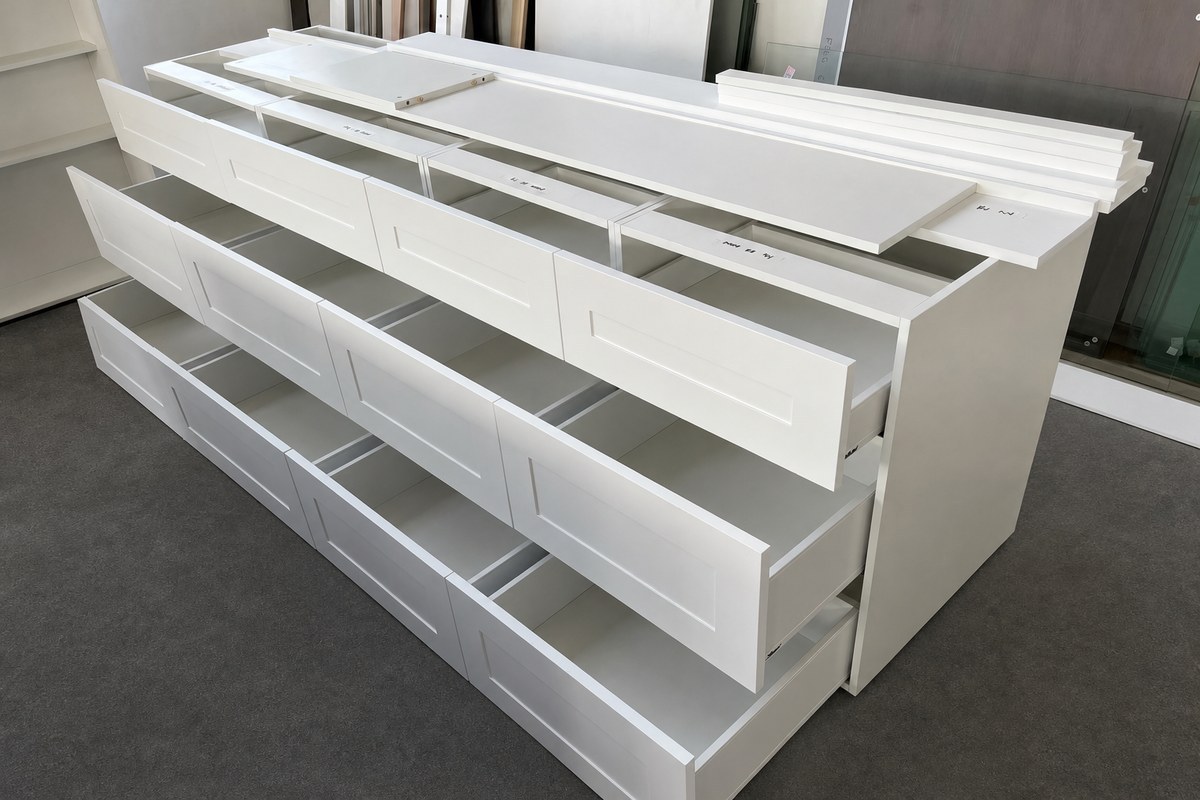
ZoneIdeal bands every edge of every panel — front, back, top, bottom, and the shelves and partitions inside. Combined with high-precision laser edge banding on PUR hot-melt adhesive, the band closes the panel core in one continuous line rather than a glued strip with a visible joint, so there is no open path for moisture or particles to follow into the board, on any side of the panel.
2. Edges inspected before packing
Edge chipping and delamination are checked in a five-stage inspection covering surface condition, millimetre-level dimensions and drilling, colour and grain matching under standardised lighting, and function testing of hinges and runners. Every panel carries a barcode recording its dimensions, position and result.
3. Hardware that survives the cycle
Hinges and soft-close slides are tested function by function before loading. In a wet room, hardware that corrodes or loosens is the first thing a homeowner notices — well before any panel shows damage.
4. Cut-outs made in the factory
Socket, LED and appliance openings are machined by CNC before the panels leave the factory, because an opening cut on site is an edge that nobody sealed. If a site cut is unavoidable, seal it the same day.
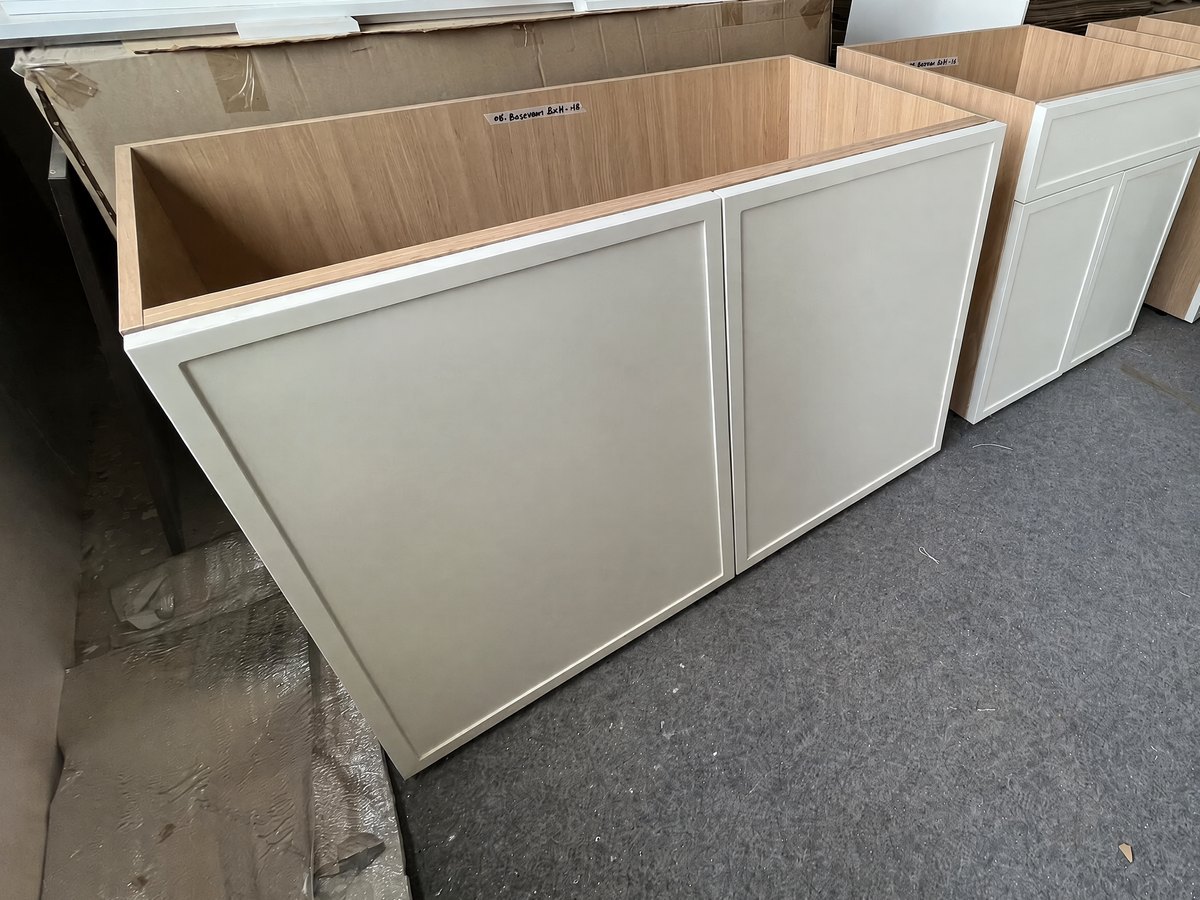
Ventilation is part of the specification. An extractor that actually moves air beats a board-grade upgrade; a steamy room with no extractor will eventually show it.
What to Ask Before You Order
- What is the carcass made of, separately from the door — the carcass is the part that meets water first.
- Are all four edges banded, or only the front, and with what adhesive — then ask to see the back edge of a carcass rather than a sample door.
- Who cuts socket and appliance openings, and how are those cuts sealed afterwards.
- What sits between the cabinet and the floor, and whether the plinth is a moisture barrier or a sponge.
Common Questions
Is plywood overkill for a bedroom wardrobe?
Often, yes — in a dry, ventilated room the sealing and hardware matter more. It stops being overkill against an external wall, in a coastal home, or in a room with an ensuite and no extractor.
Can I use MDF doors in a bathroom?
MDF is a good substrate for a painted or lacquered front, because a uniform, grain-free panel takes a smooth finish. What makes it work in a bathroom is sealing every cut edge and fixing point, pairing it with a moisture-tolerant carcass, and ventilating the room. ZoneIdeal specifies lacquered MDF fronts over a plywood carcass where the budget allows, and uses water-based, zero-VOC coating systems on lacquered and veneered finishes.
Why do some cabinets only have the front edge banded?
Because banding is paid for by the metre and only the front edge is ever looked at. On a carcass banded just at the front, the back, top, bottom and shelf edges stay raw — which is precisely where a humid room does its damage: behind the cabinet, under the worktop and behind the plinth. ZoneIdeal bands every edge of every panel, which costs more in material and machine time but keeps the core sealed on all sides, so the carcass holds its shape and its hardware alignment far longer.
Does the warranty cover humidity problems?
Every project carries a 5-year warranty covering structural integrity under normal use, hardware performance and surface finishes, plus a no-quibble replacement policy for accidental physical damage during installation or daily use. The practical point is prevention: sealed edges and a dry, ventilated room are what keep a cabinet inside those conditions. See the FAQ page for the full terms.
Does a low-formaldehyde board also resist moisture?
Not automatically — they are separate properties. ZoneIdeal specifies ENF-grade (up to 0.025 mg/m³) or E0-grade (up to 0.050 mg/m³) panels, both inside the E1 baseline of 0.124 mg/m³, and handles moisture resistance separately through board choice and edge sealing.
Choose the board by where it will live: plywood for carcasses and wet rooms, MDF for painted fronts, particle board only where every face and edge is protected. Then judge the supplier on the part nobody photographs — the back edge of a carcass. A cabinet banded only at the front has an open core on three sides; one sealed on all four keeps moisture out of the board, and that is what a longer service life is actually made of.